

Love Data Week is an international celebration of data that takes place during the week of Valentine’s Day. This year, we’re joining in on the fun by hosting five virtual sessions that celebrate data in its many forms. Learn more about five virtual events on data visualization, computational text analysis, geospatial data, data management, and an exciting guest lecture by the journalists behind a fantastic citizen science/data viz project on climate change in Canadian cities.
Data Visualization in R using ggplot2
Virtual Event on Monday February 13 | 10:30-11:30am
Presented by Subhanya Sivajothy, Data Analysis and Visualization Librarian
This virtual workshop will provide an introduction to ggplot2, an open-source data visualization package for the statistical programming language R. This workshop will go overbasic tips for creating visualizations and customizing the design of those graphs. A basic familiarity with R will be helpful for this workshop.
Introduction to Geospatial Data
Virtual Event on Tuesday February 14, 2023 | 10:30-11:30am
Presented by Christine Homuth, Spatial Information Specialist
Geospatial data is data about objects or features on or near the surface of the Earth and can be mapped using Geographic Information Systems (GIS) software. This workshop introduces participants to geospatial data formats and concepts as well as sources for this data.
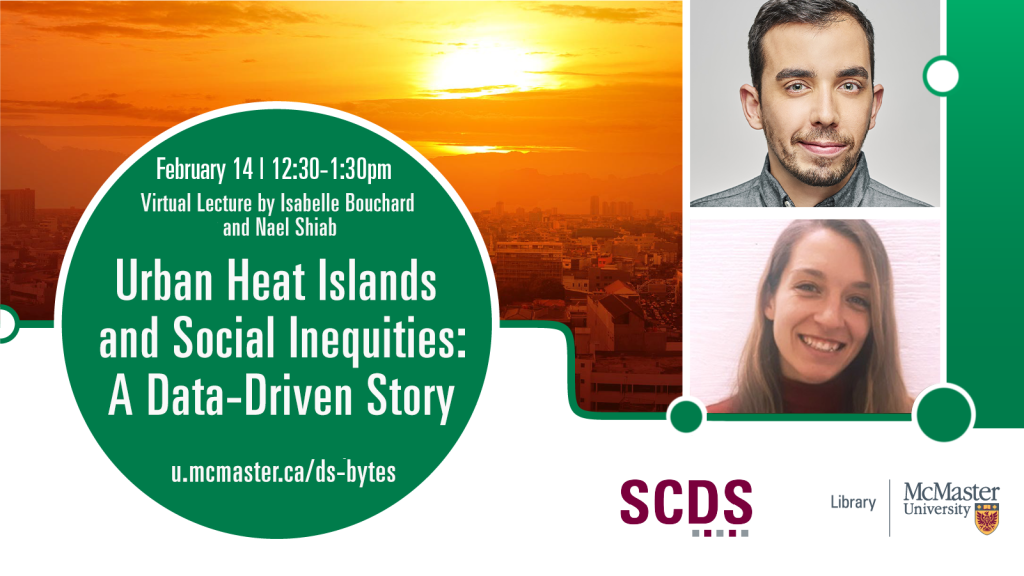
Urban Heat Islands and Social Inequities: A Data-Driven Story
Virtual Event on Tuesday February 14, 2023 | 12:30-1:30pm
Presented by Nael Shiab and Isabelle Bouchard, CBC Journalist and Data Scientist
In this talk, Nael Shiab and Isabelle Bouchard (CBC Journalists) will present their work on urban heat islands and their correlation with some demographic indicators. More specifically, this work shows that immigrants and people with low income are most likely to live in the hottest urban areas. This makes them much more vulnerable to heat waves, with deadly consequences. Shiab and Bouchard will share their methodology and discuss how they used open data to highlight social inequalities. They will also explain the role of the interactive visualization to support their story.
Read the Urban Heat Islands report.
What Are ORCiDs and DOIs–and Why Do I Need Them?
Virtual Event on Wednesday February 15, 2023 | 10:30-11:30am
Presented by Jeffrey Demaine (Bibliometrics and Research Impact Librarian) and Danica Evering (Research Data Management Specialist)
We’ve all seen a 404-error message, trying to access an old hyperlink. Link rot happens when a site is removed or a URL stops pointing to the right location. Persistent identifiers (PIDs) are reference links that can never rot and are increasingly important in an interconnected research world!
While some fields and researchers have actively incorporated PIDs for many years now, others rely on interpersonal networks and personal websites to connect their research. This workshop will give you skills to augment those important connections with PIDs.
Some might have received a Digital Object Identifier (DOI) for an article published in a journal, but they can also be used to share data (field notes, methods, audio recordings, code), connected to a website, or associated with an artwork. An Open Researcher and Contributor ID (ORCiD) is a unique link where you can connect to all your expansive scholarly output—datasets, articles, exhibitions, projects, interviews, education, residencies, and more.
Used together, PIDs can help you find new collaborators across disciplines, recognize the breadth of your work beyond journals, and allow you to connect to your research practice over time.
Computational Approaches to Text Prep & Analysis
Virtual Event on Thursday February 16, 2023 | 1:30-4:30pm
Presented by Jay Brodeur (Administrative Director of the Sherman Centre and Head of Digital Scholarship Services, McMaster University Library) and Devon Mordell (Educational Developer, MacPherson Institute)
Are you interested in textual analysis but unsure about where to start? Join us for an interactive “no experience required” introduction to the fundamental concepts, processes, and methodological approaches for preparing and analyzing text using computational approaches. Following a general introduction to the topic, participants will be guided through prepared exercises that demonstrate how different software packages (OpenRefine, Python) can be used to prepare for and perform textual analysis.
If you have any questions about these events, contact SCDS Coordinator Veronica Litt at littvs@mcmaster.ca. We hope to see you during #LoveDataWeek2023!

Leave a Reply